
24 Mar Parshas Shemini 2 articles 2 meme ; Insights on Recovery – Sacrifices – Kashruth – Reincarnation rev2026
 Parshas Shemini-5768 rev.2026
What are you Offering?
with
Insights of Addiction, the 12 Steps of Recovery
Inspired by the teachings of HaRav Yitzchak Ginsburgh and Rabbi Moshe Genuth
In the final Parshas of Shemot (the book preceding Vayikra) we are commanded to build the Mishkan, the Tabernacle. In the book of Vayikra, we are told how to use the Mishkan which includes the bringing of the Korbonos (Offerings or Sacrifices) to G-d.
Moses was commanded to erect (and take down) the Mishkan (desert Tabernacle ) on his own for 6 days. This included the erecting and sacrifices for each day, and appropriate observance of sacrifices on the 7th, Shabbos.
During this 7 day period preceding the 8th day of the formal Inauguration the Divine Light did not shine. It was on the 8th day of the Inauguration by Aaron and the Kohanim that the Divine Light appeared.
We understand ‘7’ in Jewish mysticism relate to the World of Nature (the natural world) , and ‘8’ corresponds to the ‘super-natural’ ( that which is beyond the natural).
We see the super natural expression of 8 in the inauguration of the Mishkan. We also see it on other places such as 8 days before we perform a brit Milah as the child must pass through and acquire the power of one Shabbos before the bris.
There is another lesser know kabbalistic idea that in the World of Tohu (Chaos) , prior to the birth of this World of Tikun (Rectification), there were 7 days which from its
Shabbos gave birth to the 8th day also known as the 1st day of the Creation of this World. These are but a couple of examples.
Until the destruction of the Second Temple, when the shechina (G-d’s abundant Light) rested close upon us, the ceremonies of the Korbonos were performed. The spiritual impurities that exist in today’s world do not allow us to engage in this ceremony; however there are other ways in which we can accomplish a closer relationship to G-d.
A Korbon is often translated as ‘a sacrifice’ but is more accurately translated as ‘a close maker’ or ‘to come close’. Through the process of Tshuva (to return), a process of returning to a spiritually purified state, we can come closer to G-d. The Korbon is a mechanism of Tshuva (to return [to a pristine state]).
A korbon (sacrifice or offering) is a representation …. a mechanism and conduit of a sacrifice of our ‘own self’ in some way (as defined by the particular korbon).
We say that because we don’t currently have the mechanisms of the Beis HaMikdash- The Holy Temple available for the Korbon ceremony, we are not currently required to perform the korbon ceremony. It important to know however that the available process of Tshuva we do have today to bring about a Tikun (a rectification) is done through the mechanisms of prayer, mitzvot and refining ones character. These contain all that is necessary today to accomplish the goal of bringing about the necessary Tshuva, Tikun and the Final Redemption. In these, there does exist an effective mechanism of Korbon (offering/sacrifice) as the process of ‘coming closer’ to G-d.
The Korbon
In Parshas Shemini (Shemini is ‘8th-eighth), represents the transcending of the physical world of ‘7 ’[the natural world]). The Mishkan is inaugurated by Aaron and his sons through the ceremony of the Korbonos and completed on the 8th day. Where 7 represent the natural world, 8 represents the supernatural (beyond the natural) or sprititual world. Kabbalah teaches that the world was created with Shabbos meaning there were ‘7 days that preceeded creation and with the power of the 7th day-Shabbos the world (universe) was born on the 8th day which is the 1st Day of Creation. They (the kohanim) are commanded to bring Offerings/Sacrifices to the Alter which include the tail, organs, diaphragm, blood and the fats.
As the commandment of the Korbon appears in Parshas Shemini-Chpt 7;
1. And this is the law of the guilt ioffering. It [the offering] is a Holy of Holies.
2. They shall slaughter the guilt offering in the place where they slaughter the burnt offering; and it’s blood shall be dashed upon the altar, around.
3. And all of its fat he shall offer from it: the tail and the fat covering the innards,
4. And the two kidneys [along] with the fat that is upon them, which is on the flanks, and the diaphragm with the liver; along with the kidneys he shall remove it.
5. And the Kohen shall cause them to [go up in] smoke on the altar as a fire offering to the Lord. It is a guilt offering.
The Inner significance of the Elements of a Korbon;
·The Blood – dam , represents the will. One ‘comes close’ to the Alter to spray the blood
at the sides of the Alter and placed upon the horns of the Alt
· The Choice fats – chelev, the fat that covers the inward (on the kidneys, diaphragm, liver and are parts of the body that may filter and accumulate physical and spirtitual toxins [sins]) represents pleasure of this world, and the inner dimension or second category of Choice Fats which are the…
· The Choicest of Choice, alyah (tail of animal), represents ‘pleasure of pleasure’,
spiritual pleasure. Even this we surrender to G-d in a process that will then allow G-d to grant us greater humility and an even closer relationship to G-d.
‘When a person brings a Korbon it is as if he is offering himself as a sacrifice.’
The Light of Torah as it shines to the Nations of the World-
Torah and Judaism set the benchmark for righteous living in this world. We need to know how the ‘Light of Torah’ has and may continue to effect the rest of the world, and what can we learn from the many millions of people that have received the Light of Torah? After all, a good teacher also learns from his students.
In understanding Tshuva as a process of returning to a closer relationship with G-d, and the Korbon as a mechanism to ‘come closer’ to G-d, we can see how properly elevating our transgressions to become ‘rectified mitzvoth’ is an essential part of that process of righteous living, and how then the Light of Torah shines in the world to help others rectify their ways.
Briefly, when reciting the Shema, the central prayer of unification, we are to nullify (bitul) ourselves… divest of ‘self and ego’.., to be as a sacrifice in service to G-d. One such example was Isaac at the Akaida.
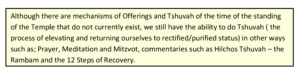
The Mechinisms of Tshuva and Recovery
The 12 Step program of Alcoholics Anonymous (‘AA’) is a program of recovery holding within it a process of Tshuvah and the Light of Torah. It has helped millions upon millions of people and has been adapted to help an array of unmanageable behaviors bringing to its followers a program of righteous living. There is a powerful connection in the 12 Step program that reflects the teachings of Hilchos Tshuva -Laws of Tshuva of the Rambam. It should be noted that the 12 step program is not a substitute for the Torah connection that a Jewish nishama (soul) requires.
STEP 3 of AA-
The third (3rd) step , is referred to as the ‘surrender’ step and reflects the understandings of Humility, a necessary trait to acquire in the process of Tshuva, Tikun and the Korbonos. Insights of Step 3 continue…
STEP 3- Turned my will and my life over to the care of G-d as I understood HIM. (AA)
This merits closer examination;
- ·To turn ones will…, suggests that I must turn or redirect my will and align myself with G-ds will. We would call this ‘Tshuva’, to turn or return to our lives in a righteous G-dly direction.
- …my will.., as we have discussed in the ceremony of the Korbon, the Korbon and ‘I’ are as one. ‘When a person brings a Korbon it is as if he is offering himself as a sacrifice….I am offering myself.’ Therefore I must be present in myself, devoid of ego, honest and humble, and I must begin to Trust and have Faith in G-d (a Greater Being) if I am effectively going to be able to surrender (offer my-being) to G-d. Here, I am offering myself up to G-d; my will…my being, my ‘self’ which because of my transgression(s) has caused me to be distanced from G-d. This relates to the Blood of the Korbon we discusses earlier.
- …and my life… as it relates to my life in the physical world of physical pleasures with the understanding that the pleasures of this world have taken me out of this world and have affected my service to G-d. There exists a paradox in that all that is physical is here for my pleasure, but that pleasure, although may be experienced physically is to be recognized as a spiritual pleasure that bring me closer to G-d, my Higher Power in my service to Him. This is true and dependent on our free will. If I use all this world has to offer in a positive way… by serve G-d, myself and others in an elevating and appropriate way, I will affect positive change. However, if my free will and all that this world has to offer is used inappropriately, the pleasure gained will be detrimental to my spiritual and often physical state of being. These are related to the Fats as discussed earlier
- …to the care of G-d…refers to the inner dimension of pleasure, the alyah-tail of the Korbon. This dimension known as the ‘pleasure of pleasure’ and is associated with emunah or ‘simple faith’. Even this, our ‘simple faith’… we surrender to G-d our spiritual pleasure in what becomes like an ‘exchange’ to a higher level of faith. When we surrender our faith (our spiritual pleasure) to G-d, it can then come back to us even greater. This is the highest level of surrender, and a level of truly giving ones life to the care of G-d.
Every person is a piece of G-d…. as an individual and as an integral part of something greater than ones self. The closer we come to G-d, the greater our clarity becomes in believing and knowing the Goodness of His love and His care for me.
- …as I understood (understand) HIM. The experience of G-d may be experienced as a continuum. The two words ‘understood’ and ‘understand’ are both written here for the purpose of this explanation. It is important to remember that when written as ‘understood’ refers to the past tense, and when written as understand, it is present tense. The present tense refers to a relationship with G-d ‘at this point in time’. It is a point in time we may feel we are close to G-d’s reality. The process of the Korbon and the 12 Step program is a process of coming closer, bringing one closer to living ‘in the moment’ or perhaps more accurately, closer to living in G-d ’s reality. A relationship with G-d is a process in which we grow closer to increasingly come to believe and know G-d.
As we may read again…
STEP 3- Turned my will and my life over to the care of G-d as I understood HIM. (AA)
This 3rd Step of ‘surrender’ is key to acquiring a ‘closer’ connection to G-d in a ‘process’ in which one can acquire the trait of Humility (and Sincerity -Hod) through a process of nullification -bitul (and or self deprecation -shiflut) of one’s own will (ego). This is imperative in having a closer relationship with G-d. A person who wants to transform and elevate his transgressions must subjugate himself and his will… his body, mind and soul to G-d.
It is in the process of the Korbonos (sacrifice/offerings) and the resulting elevated connection to G-d, we can experience the Light of Torah and it’s positive effect on ourselves and the world today. With the process of Tshuva, as we also can also reflected in the 12 Step Recovery Programs, is the ability of evolution, transformation and elevation by coming closer to G-d as in the ceremony of the Korbon of the Torah.
OH YES, we have no Korbonos…
Although we do not have the Holy Temple today to be able to perform the ceremony of the Korbonos, we do still have the available mechanisms in it’s place to come closer to G-d through the process Tshuva and the bringing about of a Tikun (rectification) by elevating ourselves and the world from a deficient state of our thoughts and actions. We do this through the mechanism mitzvot, prayer, and the learning and living of Torah. This enables us us to come closer to G-d until such time as Mashiach arrives and the ceremony of Korbonos will once again be resurrected.
Have a great Shabbos,
Leib Getzel (Lawrence) Lax
Addictions and Counseling (Hnrs)
www.lawrencelax.com
lawrenceJlax@gmail.com

Parshas Shemini talks about various aspects of kashruth and holds concealed insights of reincarnation.
Inspired by the teachings of HaRav Yitzchak Ginsburgh and Rabbi Moshe Genuth
Beyond halachcic academic wisdom of kashruth there are important dimensions of kashrtuh that may have become overlooked.
We need to recognize kashruth is more than a heksher or an intellectual academic exercise. It is a way of maintaining a conscious connection , body, mind and soul through a most repetitive daily acts of food. It is a moment each time to Stop, Think, Do. Kashruth binds an individual and a community together in Unity with our conscious connection to G-d in many ways, many times each day.
The following article will reveal from the Arizal, deeper insights of the journey and rectification of the soul and its culmination as the Unified-Yichud soul of Klol Yisroel. We will see how even the act of eating is an integral part of the journey of an individual and a Nation.
Although kashruth is a ‘chook’; Devine Decrees that by definition are concepts of infinite qualities which cannot be known, we still may understand from it valuable lessons.
The Holy Ari teaches the Kabbalistic insight that sparks of holiness in a Jew (his soul) that have not been rectified may return or descend in to 1 of 4 taxonomical Kingdoms;
1/ A Man – Speaker (as 1A/ Jew or 1B/Non Jew)
2/ Animal
3/ Horticultural
4/ Mineral
A soul may often transmigrate as a ‘fraction’ of a soul so that only that part of the soul needs to undergo a greater refinement will ‘migrate’. One such incarnation of a past souls’ descent as-a-yet unrectified spark, may find its Tikun- Rectification concealed in a non Jew (in which case the migrant Jewish spark may become rectified through a kosher orthodox conversion) , or may be (amongst many possibilities) be concealed as a spark of a soul has come to rest in a cow that is chosen to be prepared kosher; sheckted, and cooked in an appropriately kosher way. As the food is blessed, the process of furthering the release of the concealed sparks of holiness.
The yet unrectified soul in its journey is a concealed spark holiness in that meat that then becomes part of that Jews soul who consumed the meat , and on behalf of the one who was unable rectify himself, the pieces of the the fallen sparks have now traveled to another Jew who through his Mitzvot will hopefully elevate himself and the acquired unrectified spark. He will have done a tikun for himself and the inclusive unrectified spark of the soul he consumed, ultimately benefiting all of mankind and the Unity-Yichud (Oneness) of the Rectified Jewish Nation.
We can elevate the sparks of a Jewish soul where our fellow Jew of past was unable to.
By eating kosher food and by living, learning and teaching Torah we can elevate ourselves… and benefit others where they may not increase Hashems Light. Ultimately fulfilling the ultimate goal of the Jewish soul to be united as One Soul as Unity -Yichud in the World to Come.
Observance and Kashruth; A Great Unifier
For those of us living in communities where there may be various levels of observance, so keeping kosher in and out of the home can be a challenge.
Kashruth affects the spiritual and physical aspects of our life as it enables us to ignite the spiritual sparks of holiness in our preparation and eating of food, and inspires us to often have a G-d conscious experience. It is an observance that in many ways unifies Jewish communities.
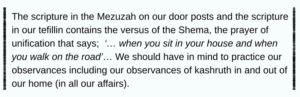
Our journey in Orthodox Judaism included an orthodox conversion from a recognized orthodox beit din. Accordingly, our kashruth observance was set out by the beit din and our Rabbi and would also allow us to invite guests to our home from a diverse range of observance. We also understood that keeping kosher outside our home would be a reflection on our observance. For us, kashruth became more than a set of rules for food, it became a way of having an ongoing and growing conscious awareness of G-d and Torah.
In order to maintain our observance in our community of diverse observance, we needed to have some guidelines not only for our own home, but also for eating at other people’s homes that would be in accordance with the beit din and our Rabbi. We needed to understand how others may be observing kashruth;
- Are all adults in the home Shomer Shabbos?
· Does the head(s) of the household have an ongoing kesher (connection) with a sole Rabbi for questions of observance (kashruth)
· Does the household keep kashruth to observant standards of your Rabbi and the Beit Din.
· Does the man of the household daven regularly and learn Torah regularly.
· Does the married woman of the home cover and dress tsniut (dresses).
· Are there older children or others in the homes that are not observant?
·Have a single Rabbi and Consult him.
These guidelines should not to be viewed as a judgment on others observance but a way to maintain our own observance and in doing so we hope to maintain a kosher home where a diverse level of observant Jews can feel comfortable in our home.
There may be common exceptions or stringencies in the observance of kashruth from other communities or individuals such as;
- Pas Yisroel; refers to baked goods that were baked with the participation of an observant Jew
· Cholev Yisroel; refers to milk and dairy products that have been supervised by an observant Jew from the time of milking to bottling
· Lebovitch/Chabad shchita/slaughter of meats; a stricter standard of kosher ritual slaughter performed according to the traditions of the Lubavitch movement.
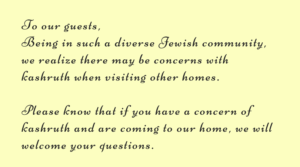
Because we live in a diverse community of observance, when we invite someone for the first time we share the following;
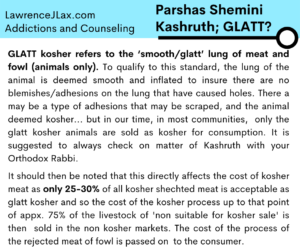
For deeper kabbalistic insights on Kashruth and Reincarnation see;
Leib Getzel (Lawrence) Lax
Addictions and Counseling
http://LawrenceLax.com
lawernceJlax@gmail.com